The shared portrait standard
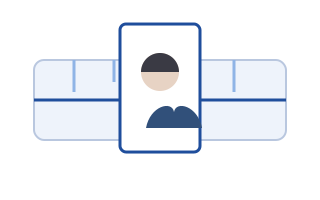
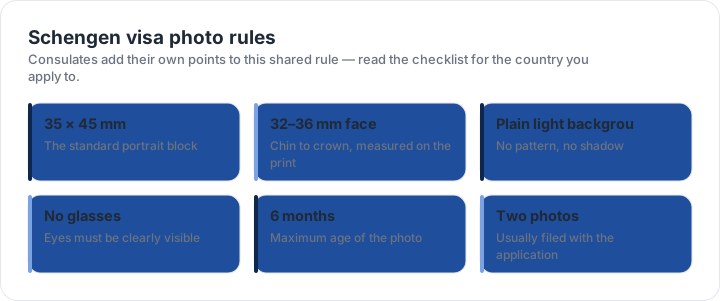
The block is 35 × 45 mm — the same portrait proportion used by the UK, Japan, Australia and Irish passports — with a plain light background and no pattern, shadow or object behind the subject. The head and the top of the shoulders are in the frame, and the face is centred rather than angled.
The shared rules also cover what the photo may not show: no glasses, because the eyes have to be clearly visible; no filters or edits; a photograph taken within the last six months; and an expression that is neutral and natural rather than posed. Two photos are usually filed with the application, so ask for a pair rather than a single print.
The face band: 32 to 36 mm
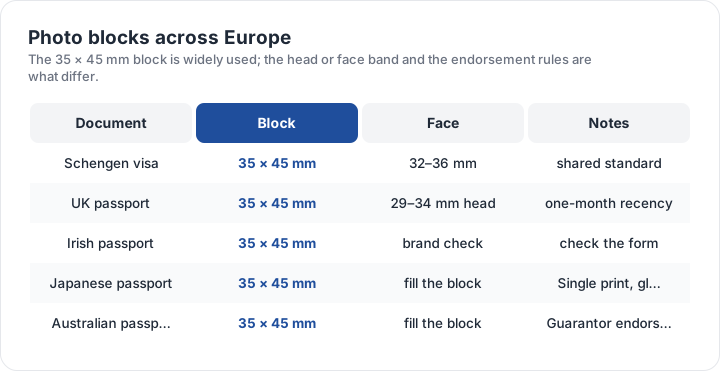
Where the UK states a 29–34 mm head band on the same block, the Schengen standard states a face of at least 32 mm and up to about 36 mm from chin to crown. That is a slightly larger face in the same rectangle, and it is the measurement most often missed by people who prepare one photo for several European applications.
The practical effect is small but real: a photo cropped for a UK application may sit a few millimetres short of the Schengen band, and a few millimetres is enough for a clerk with a ruler. If you need both, take the photograph once and produce two crops — one aimed at each band — rather than trying to find a single crop that satisfies both.
A sharp photo can still be a rejected photo. The rules that send applications back are measurements — the block, the head band, the background lightness — so the fastest check is a measurement, not a second opinion from a friend. The checker takes that measurement from your own file.
Where Schengen rules stop being uniform
The block and the face band are shared, but the checklist attached to a visa application is issued by the consulate handling it, and those checklists add their own points: how many photos, whether the back may be marked, whether the photo has to be attached by the applicant or accepted loose. The shared standard travels well across Europe; the paperwork does not.
That is why the block is the safe thing to standardise and the checklist is the thing to read. A photo prepared to 35 × 45 mm with a 32–36 mm face, on a plain light background, without glasses, is the right starting point for any Schengen application — and then the consulate’s own notes decide the details. The size matrix shows the neighbouring blocks, and the Schengen checker preset measures the proportion and the background of your own file.
Preparing a pair of Schengen photos
- Read the consulate’s checklistShared rules plus the points added by the country you apply to.
- Shoot against a plain light wallHalf a metre away, daylight on the face, nothing behind you.
- Crop to 35 × 45 mmFace 32–36 mm from chin to crown, head centred and uncropped.
- Print two identical copiesOn photo paper, at 300 dpi, with no border.
- Check before you fileNo glasses, no shadow, no colour cast and no visible editing.
Because two photos are filed, a fault on one usually means reprinting both — consulates expect the pair to be identical, and a photo trimmed in one application and not the other stops matching. Print three: two to file and one to keep, so a retake after submission is not a second appointment. The background guide covers the light faults that cause most refusals in visa photographs.
| Requirement | What the official rule says | |||||||
|---|---|---|---|---|---|---|---|---|
| ('Country / document', 'Europe — Schengen visa — printed photo') | ('Printed size', '35 × 45 mm') | ('Head height', '32–36 mm chin to top of head') | ('Digital upload', 'Not applicable — this one is filed on paper') | ('File format & size', 'Photo paper, no file limits') | ('Background', 'Plain light background') | ('Recency', 'Taken within the last 6 months') | ('Glasses', 'No glasses; eyes must be clearly visible') | ('Official source', 'Official page') |
| ('Country / document', 'United Kingdom — UK passport — printed photo') | ('Printed size', '35 × 45 mm (1.38 × 1.77 in)') | ('Head height', '29–34 mm chin to top of head') | ('Digital upload', 'Not applicable — this one is filed on paper') | ('File format & size', 'Photo paper, no file limits') | ('Background', 'Plain cream or light grey background') | ('Recency', 'Taken in the last month') | ('Glasses', 'No glasses') | ('Official source', 'Official page') |
| ('Country / document', 'Japan — Japanese passport — printed photo') | ('Printed size', '35 × 45 mm') | ('Head height', 'Not specified as a fixed band — keep the head centred and uncropped') | ('Digital upload', 'Not applicable — this one is filed on paper') | ('File format & size', 'Photo paper, no file limits') | ('Background', 'Plain background, no shadows') | ('Recency', 'Taken within the last 6 months') | ('Glasses', 'No glasses with coloured or dark lenses') | ('Official source', 'Official page') |
Specification source: https://home-affairs.ec.europa.eu/policies/schengen-borders-and-visa/visa-policy_en · checked October 2026 · Schengen short-stay visa applications.