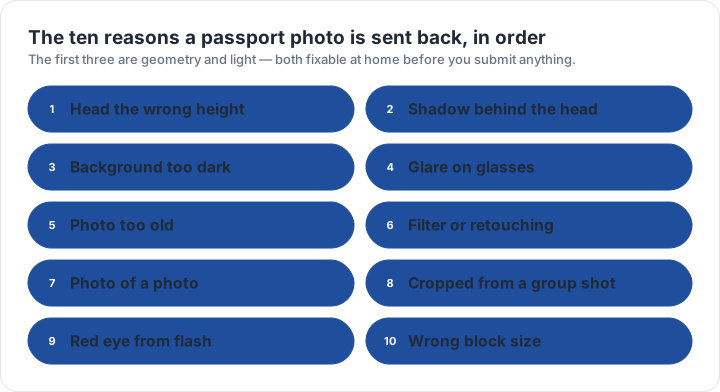
The ten causes, in order of how often they appear
Head the wrong height: too small because the photo was framed to include the shoulders, or cropped at the top. Shadow behind the head: the light was close, above or behind, and the shadow landed inside the frame. Background too dark: a wall lighter than it looks, exposed for the face. Glare on glasses: a reflection across the eye, which is why several countries banned glasses outright. Photo too old: outside the recency window, whether six months or, in the UK, one month.
Then the second five: a filter or retouching, including red-eye removal and skin smoothing; a photograph of a printed photo, which is rejected as a digital upload; a crop taken out of a group shot, which leaves visible shoulders or a stray edge; red eye or a reflection from flash; and the wrong block size, which is a form-fitting failure rather than a photographic one. The background guide and the size matrix cover the two most fixable groups.
Why geometry beats photography
The recurring pattern is that quality is rarely the problem. A phone photograph taken in daylight against a plain wall is often sharper and better exposed than a photo-booth print, and still rejected, because the head occupies the wrong share of the frame. Judges of a photograph and systems that measure one look at different things.
That is why the fastest route to a photo that survives the counter is measurement rather than another attempt. The block, the head band, the background lightness at the frame edge and the file limits are all numbers, and numbers can be checked in seconds — which is what the checker does, from the file, in your browser.
The checker reports measurements, not approval. It tells you which published rule your file fails and by how much, from the pixels of the file in your browser. The decision always belongs to the authority you file with.
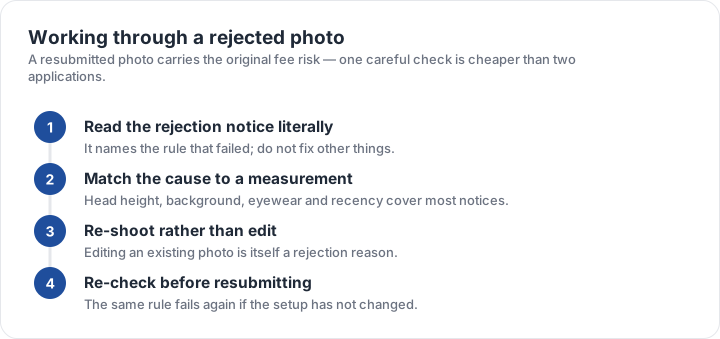
Working through a rejection
- Read the notice literallyIt names the rule that failed; do not fix other things at the same time.
- Match the cause to a measurementHead height, background, eyewear and recency cover most notices.
- Re-shoot rather than editEditing an existing photo is itself a rejection reason, everywhere.
- Change the setup, not the fileThe same rule fails again if the light and distance have not moved.
- Re-check before resubmittingA second return costs another round of fees and waiting.
The one cause that cannot be diagnosed from a rejection notice alone is the wrong block size, because the notice often says only that the photo is unacceptable. Measure the print against the number printed on your form in that case: a Chinese visa photo is 33 × 48 mm, a Canadian photo 50 × 70 mm, and a U.S. photo 51 × 51 mm, and none of them can be trimmed into another without clipping the head.
What not to do after a rejection
Four habits make a second rejection more likely. Retouching the same photo to look better, which adds an editing fault to whatever caused the first return. Reusing a print from an earlier application, which risks failing the recency rule silently. Asking a friend for a second opinion, which produces a judgement about the photograph rather than a measurement of it. And resubmitting the same photograph with a different crop, which changes the block but not the head band if the band was the problem.
What works is to identify the single failing measurement, change the setup so that measurement lands inside its range, and check it before filing. The at-home guide covers the setup changes in order, and the where-to-get-one page covers the cases where the answer is to let a counter or a studio do the whole job instead.
| Requirement | What the official rule says | |||||||
|---|---|---|---|---|---|---|---|---|
| ('Country / document', 'United States — U.S. passport — printed photo') | ('Printed size', '51 × 51 mm (2 × 2 in)') | ('Head height', '25–35 mm chin to top of head') | ('Digital upload', 'Not applicable — this one is filed on paper') | ('File format & size', 'Photo paper, no file limits') | ('Background', 'Plain white or off-white, no shadows') | ('Recency', 'Taken within the last 6 months') | ('Glasses', 'No glasses — the rule changed in November 2016') | ('Official source', 'Official page') |
| ('Country / document', 'United Kingdom — UK passport — printed photo') | ('Printed size', '35 × 45 mm (1.38 × 1.77 in)') | ('Head height', '29–34 mm chin to top of head') | ('Digital upload', 'Not applicable — this one is filed on paper') | ('File format & size', 'Photo paper, no file limits') | ('Background', 'Plain cream or light grey background') | ('Recency', 'Taken in the last month') | ('Glasses', 'No glasses') | ('Official source', 'Official page') |
| ('Country / document', 'Canada — Canadian passport — printed photo') | ('Printed size', '50 × 70 mm') | ('Head height', '31–36 mm chin to top of head') | ('Digital upload', 'Not applicable — this one is filed on paper') | ('File format & size', 'Photo paper, no file limits') | ('Background', 'Plain white or light-coloured background') | ('Recency', 'Taken within the last 6 months') | ('Glasses', 'Dark glasses and tinted lenses not accepted; clear prescription glasses must not hide the eyes') | ('Official source', 'Official page') |
| ('Country / document', 'China — Chinese visa — printed photo') | ('Printed size', '33 × 48 mm') | ('Head height', 'Not specified as a fixed band — keep the head centred and uncropped') | ('Digital upload', 'Not applicable — this one is filed on paper') | ('File format & size', 'Photo paper, no file limits') | ('Background', 'Plain white background') | ('Recency', 'Taken within the last 6 months') | ('Glasses', 'No glasses; no headwear except religious headwear') | ('Official source', 'Official page') |
Specification source: https://travel.state.gov/content/travel/en/passports/how-apply/photos.html · checked October 2026 · DS-11, DS-82 by mail, and any paper application.
Specification source: https://www.gov.uk/photos-for-passports/photo-requirements · checked October 2026 · Paper application (form for overseas or postal applications).
Specification source: https://www.canada.ca/en/immigration-refugees-citizenship/services/canadian-passports/photos.html · checked October 2026 · Paper application, 2 identical photos.
Specification source: https://www.visaforchina.cn/ · checked October 2026 · Visa application submitted to a Chinese visa centre.