A different rectangle: 50 × 70 mm
A Canadian passport photo is 50 mm wide and 70 mm high — noticeably taller than the 35 × 45 mm portrait used across Europe, and further from a square than anything else on this site. It cannot be cut from a 2 × 2 inch print without losing either the top of the head or the shoulders, and staff at a passport office will not trim one to fit.
The block is printed on the application form and on the guidance the photographer receives, so the number to ask for is simply 50 × 70 mm. There is no border and no white margin: the printed image runs to the edge of the block on all four sides.
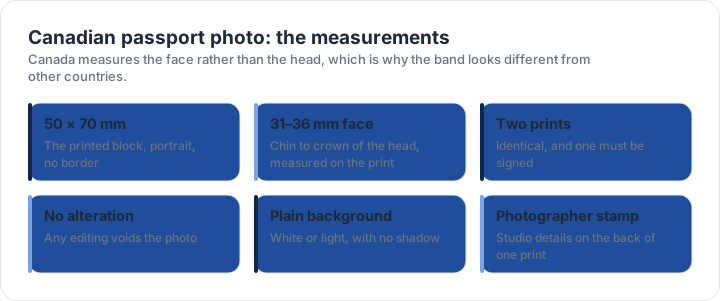
Canada measures the face, not the head
The band is 31–36 mm, and it is measured from the bottom of the chin to the crown of the head. That reads like the U.S. and UK bands but is not interchangeable with them, because the block it sits inside is a different shape. On a 70 mm tall photo, a 31–36 mm face occupies a smaller share of the height than the same measurement would on a 45 mm tall photo.
The background is plain white or light-coloured, and the photo must be identical to its twin — same image, same crop, same print. Dark glasses and tinted lenses are not accepted; clear prescription glasses are only allowed where they do not hide the eyes, which in practice means the safest route is to remove them.
A sharp photo can still be a rejected photo. The rules that send applications back are measurements — the block, the head band, the background lightness — so the fastest check is a measurement, not a second opinion from a friend. The checker takes that measurement from your own file.
The photographer’s stamp, and the no-alteration rule
The application needs two identical prints, and the back of one must carry the photographer’s stamp: the studio’s details and the date the photo was taken. A photo printed at home does not have a stamp, and handwriting the details in is not the same as a studio stamp — which is why most Canadian applicants use a commercial photographer rather than a booth or an app.
The second half of that page is a flat prohibition on alteration. No cropping after the fact, no retouching, no colour correction, no digital clean-up of a blemish. A photo that has been edited is rejected even when it looks better than the original, so the file the photographer produces is the one to file.
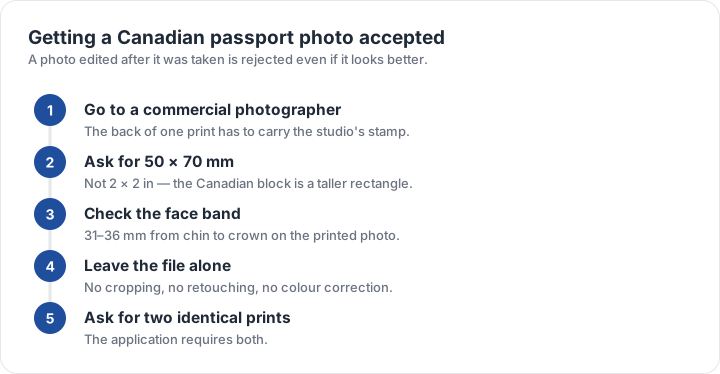
Getting a Canadian photo accepted
- Go to a commercial photographerThe back of one print has to carry the studio’s stamp.
- Ask for 50 × 70 mmNot 2 × 2 inches — the block is a taller rectangle with no border.
- Check the face band31–36 mm from chin to crown, measured on the printed photo.
- Leave the image aloneNo cropping, no retouching and no colour correction after the shoot.
- Take two identical printsThe application requires both, and one is stamped.
Because the block is unusual, it is worth checking the print before you leave the studio rather than at home. If the face measures short or long, the photographer can re-print from the same file in a minute; if the print is cut wrong, the appointment is wasted. The Canadian checker preset reports the aspect ratio and the provisional face band from your file, and the size matrix shows how much taller this block is than the European standard.
| Requirement | What the official rule says | |||||||
|---|---|---|---|---|---|---|---|---|
| ('Country / document', 'Canada — Canadian passport — printed photo') | ('Printed size', '50 × 70 mm') | ('Head height', '31–36 mm chin to top of head') | ('Digital upload', 'Not applicable — this one is filed on paper') | ('File format & size', 'Photo paper, no file limits') | ('Background', 'Plain white or light-coloured background') | ('Recency', 'Taken within the last 6 months') | ('Glasses', 'Dark glasses and tinted lenses not accepted; clear prescription glasses must not hide the eyes') | ('Official source', 'Official page') |
Specification source: https://www.canada.ca/en/immigration-refugees-citizenship/services/canadian-passports/photos.html · checked October 2026 · Paper application, 2 identical photos.