
Rule one: the narrow block
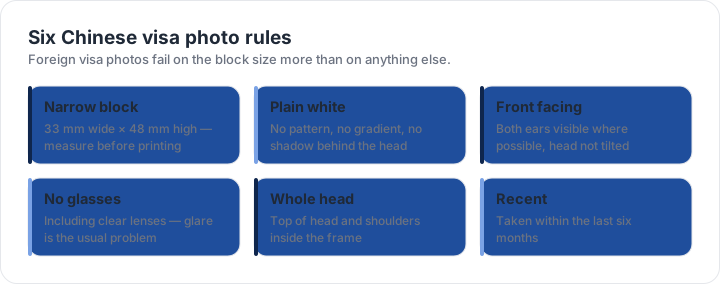
The photograph is 33 mm wide and 48 mm high. That is 7 mm narrower than a U.S. square and 2 mm narrower than the 35 × 45 mm portrait used across Europe, which is exactly why a photo printed for another country ends up being trimmed at the visa centre. Trimming takes millimetres off the sides of the face, and a clipped ear or hairline is a rejection reason.
The block is a form-fitting requirement rather than a style preference. If the photo does not sit inside the printed box on the application, it will not be accepted, however good the likeness is. Measure before you print, and ask the counter for 33 × 48 mm by number.
Rules two to six
Plain white background, with no pattern, no gradient and no shadow behind the head. Front-facing, with both ears visible where they are normally uncovered and the head held level rather than tilted. No glasses, including clear lenses, because glare across the eye is treated as a defect. The whole head and the top of the shoulders inside the frame, centred. And a photograph taken within the last six months.
A sixth point sits behind all of them: the image must be unedited. No filters, no skin smoothing, no colour grading, no reshaping. Chinese systems check that the photograph is an original rather than a processed derivative, and a visibly retouched image is rejected even when every numeric rule is met.
The most common mistake is geometrical, not photographic. A sharp phone photo whose head fills the wrong share of the frame is rejected, while a plainer one with the head inside the band passes. The checker measures exactly that.
Order of work that saves a second trip
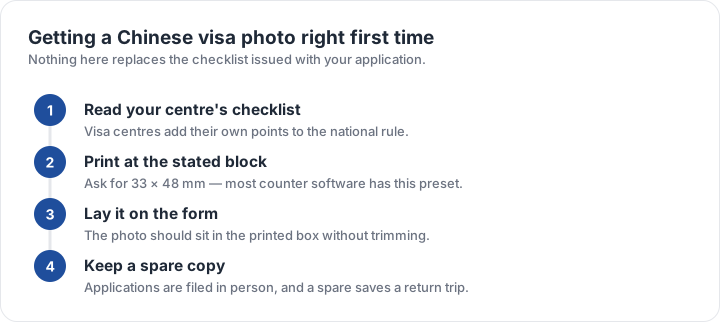
- Read your visa centre’s checklistCentres add their own points to the national rule.
- Print at 33 × 48 mm exactlyAsk for the number; most counter software has a manual entry.
- Lay the print on the formIt should sit in the box without trimming and without white slivers.
- Check the three light faultsShadow behind the head, colour cast at the edges, glare on lenses.
- Keep a spareApplications are usually filed in person, and a spare copy is cheap insurance.
Visa centres are strict about consistency: if they trim one photo and not the identical spare, the two no longer match, and the application can be held over a detail that costs nothing to get right the first time.
What to check before you leave the counter
Hold the print at arm’s length and look for a shadow line behind the shoulder, a yellow or grey tinge in the corners, and a head that touches the top edge of the block. Those three faults are visible in the hand and invisible in a hurry, and all three are cheaper to fix at the counter than at a visa centre.
For the block measurement itself, the China photo size page explains the 33 × 48 mm proportion and how it compares with the U.S. square, while the checker preset for the Chinese block reports the aspect ratio and the background lightness from the file itself.
| Requirement | What the official rule says | |||||||
|---|---|---|---|---|---|---|---|---|
| ('Country / document', 'China — Chinese visa — printed photo') | ('Printed size', '33 × 48 mm') | ('Head height', 'Not specified as a fixed band — keep the head centred and uncropped') | ('Digital upload', 'Not applicable — this one is filed on paper') | ('File format & size', 'Photo paper, no file limits') | ('Background', 'Plain white background') | ('Recency', 'Taken within the last 6 months') | ('Glasses', 'No glasses; no headwear except religious headwear') | ('Official source', 'Official page') |
Specification source: https://www.visaforchina.cn/ · checked October 2026 · Visa application submitted to a Chinese visa centre.