
A narrow block, and why it matters
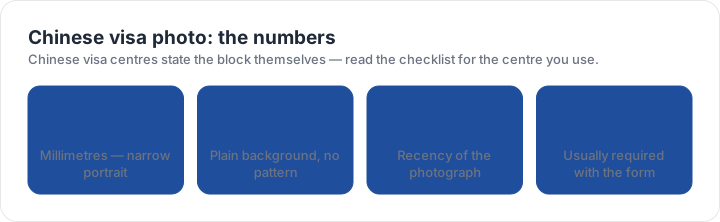
Chinese passport and visa photographs are 33 mm wide by 48 mm high — the same proportion as a 35 × 45 mm portrait, scaled slightly down on the width. It does not match any default setting on a self-service photo booth, which is why photos printed for another country are frequently handed back at a visa centre.
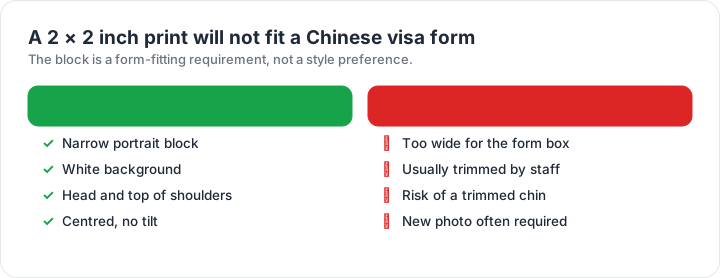
The block exists because it has to fit a printed box on the application form. A 51 × 51 mm square, or even a 35 × 45 mm portrait, will not sit inside it: staff trim it, and a trim from a 35 mm width down to 33 mm shaves a millimetre off each side of the face, which can clip an ear or a hairline.
The rules attached to the block
The background is plain white with no pattern, gradient or shadow behind the head. The photograph must be front-facing with the whole head and the top of the shoulders inside the frame, and it should have been taken within the last six months. Glasses are not permitted, including clear lenses, again because of glare.
Headwear is allowed only where it is religious, and it must not cover the face or cast a shadow. No photograph from a family album, no selfie arm in frame, and no filter or retouching: Chinese systems check for an unedited original as strictly as the geometry.
The most common mistake is geometrical, not photographic. A sharp phone photo whose head fills the wrong share of the frame is rejected, while a plainer one with the head inside the band passes. The checker measures exactly that.
Printing to 33 × 48 mm without drama
- Ask for the number, not the nameSay 33 × 48 mm; staff at a counter can enter it directly.
- Lay the print on the formIt should drop into the printed box without trimming.
- Check the head is not clippedTop of head and the jawline both fully inside the block.
- Keep a spare copyApplications are usually filed in person; a spare saves a return trip.
If a counter cannot set an unusual block, print at home: a photo shop will print a 4 × 6 inch sheet with several copies of a correctly cropped file on it, and the crop is what matters, not the paper size. The checker preset for the Chinese block reports the aspect ratio and the background before you spend anything on a print.
Where this block is used
Chinese visa centres state the block themselves, and individual centres add their own notes to the national rule, so the checklist issued with your application is the document to read first. The same 33 × 48 mm proportion appears on passport applications and on visa forms, which is convenient: a photo prepared for one is usually the right shape for the other.
For the full set of eligibility points around the photo, the Chinese visa requirements page lists six rules in the order they are checked, and the size matrix shows how much narrower this block is than the U.S. square.
| Requirement | What the official rule says | |||||||
|---|---|---|---|---|---|---|---|---|
| ('Country / document', 'China — Chinese visa — printed photo') | ('Printed size', '33 × 48 mm') | ('Head height', 'Not specified as a fixed band — keep the head centred and uncropped') | ('Digital upload', 'Not applicable — this one is filed on paper') | ('File format & size', 'Photo paper, no file limits') | ('Background', 'Plain white background') | ('Recency', 'Taken within the last 6 months') | ('Glasses', 'No glasses; no headwear except religious headwear') | ('Official source', 'Official page') |
Specification source: https://www.visaforchina.cn/ · checked October 2026 · Visa application submitted to a Chinese visa centre.