Why infant photos get rejected
Every rule that applies to an adult applies to an infant: the block, the head band, a plain light background, a neutral face with both eyes open and the mouth closed, no hands or comfort objects in the frame, and the same recency window. Babies are also expected to be photographed with their eyes open, which is the rule people assume must be relaxed and is not.
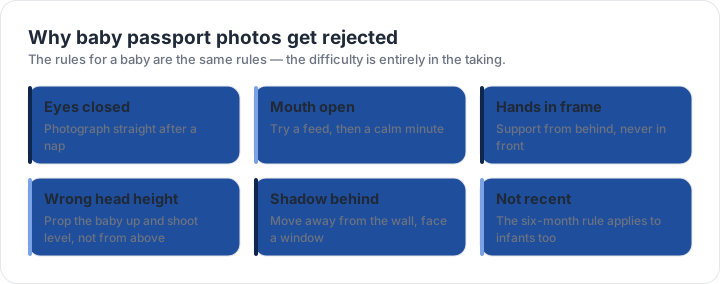
That is why the failure list for infant photos looks different from the adult one. Eyes closed, mouth open, a hand or a dummy in frame, a head propped at the wrong height, and a shadow falling behind the head because the baby is lying against a support. All five are taking problems rather than photograph problems, and all five are avoidable with the right setup.
Getting eyes open and a closed mouth
Timing carries most of it. The calm, awake window just after a feed and before a nap is the one that works: the baby is alert, usually still, and disinclined to protest. A feed immediately before also closes the mouth without a dummy in frame, which solves the second problem and the first at once.
Support matters as much as timing. Hold the baby upright against your shoulder with your hands behind the head and back, and have the camera at the baby’s face level — not above, which makes the head look small and the eyes look down. If you lie the baby flat, use a firm support under a plain white sheet and shoot straight down, which keeps the head in the band but risks flattening the lighting. Either way, no part of you should be inside the frame.
The checker reports measurements, not approval. It tells you which published rule your file fails and by how much, from the pixels of the file in your browser. The decision always belongs to the authority you file with.
Photographing a baby, step by step
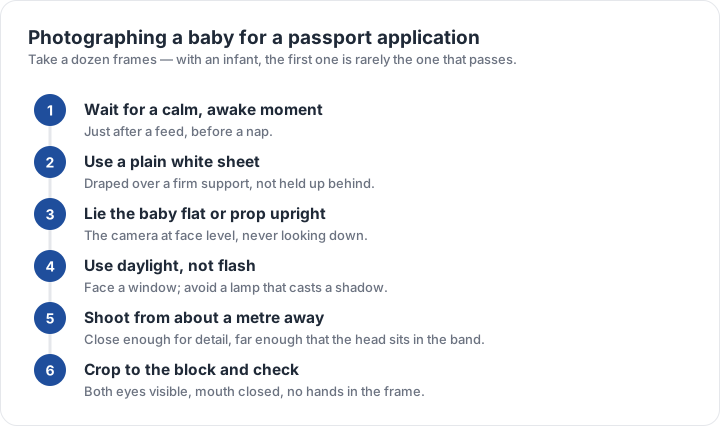
- Wait for a calm, awake momentJust after a feed, before a nap, no dummy in place.
- Set up a plain white surfaceA sheet over a firm support, not held up behind the baby.
- Position at face levelUpright against your shoulder, or lying flat with the camera above.
- Use daylight, never flashFace a window; avoid a lamp that casts a shadow on the wall.
- Shoot from about a metreClose enough for detail, far enough that the head fits the band.
- Take a dozen framesThen pick one with both eyes open and the mouth closed.
A dozen frames sounds excessive and is not: with an infant, the first one is rarely the one that passes. Check each candidate at full size rather than as a thumbnail, because a mouth that looks closed on a phone preview can be visibly open at print size.
Cropping, printing and the second attempt
Once you have a frame, crop it to the block your document states — 51 × 51 mm for a U.S. passport, 35 × 45 mm for a UK or Schengen application — with the head inside the band. For an infant the head is often smaller in the frame than you expect, so crop closer than instinct suggests and check the proportion rather than eyeballing it.
Photograph the baby fresh for each application if the forms are filed months apart: an infant changes more in three months than an adult does in three years, and the six-month photograph window that most countries allow is generous for an adult and borderline for a baby. The checker measures the block, the background and the file limits from whatever frame you choose, the at-home guide covers the lighting setup in detail, and the size matrix shows which block each form asks for.
| Requirement | What the official rule says | |||||||
|---|---|---|---|---|---|---|---|---|
| ('Country / document', 'United States — U.S. passport — printed photo') | ('Printed size', '51 × 51 mm (2 × 2 in)') | ('Head height', '25–35 mm chin to top of head') | ('Digital upload', 'Not applicable — this one is filed on paper') | ('File format & size', 'Photo paper, no file limits') | ('Background', 'Plain white or off-white, no shadows') | ('Recency', 'Taken within the last 6 months') | ('Glasses', 'No glasses — the rule changed in November 2016') | ('Official source', 'Official page') |
| ('Country / document', 'United Kingdom — UK passport — printed photo') | ('Printed size', '35 × 45 mm (1.38 × 1.77 in)') | ('Head height', '29–34 mm chin to top of head') | ('Digital upload', 'Not applicable — this one is filed on paper') | ('File format & size', 'Photo paper, no file limits') | ('Background', 'Plain cream or light grey background') | ('Recency', 'Taken in the last month') | ('Glasses', 'No glasses') | ('Official source', 'Official page') |
| ('Country / document', 'United States — U.S. passport — digital upload') | ('Printed size', '51 × 51 mm') | ('Head height', '25–35 mm chin to top of head') | ('Digital upload', '600 × 600 px minimum, up to 1200 px') | ('File format & size', 'JPG, JPEG, PNG, HEIC, HEIF, under 10 MB') | ('Background', 'Plain white or off-white, no shadows') | ('Recency', 'Taken within the last 6 months') | ('Glasses', 'No glasses') | ('Official source', 'Official page') |
Specification source: https://travel.state.gov/content/travel/en/passports/how-apply/photos.html · checked October 2026 · DS-11, DS-82 by mail, and any paper application.
Specification source: https://www.gov.uk/photos-for-passports/photo-requirements · checked October 2026 · Paper application (form for overseas or postal applications).