Four jobs, one photograph
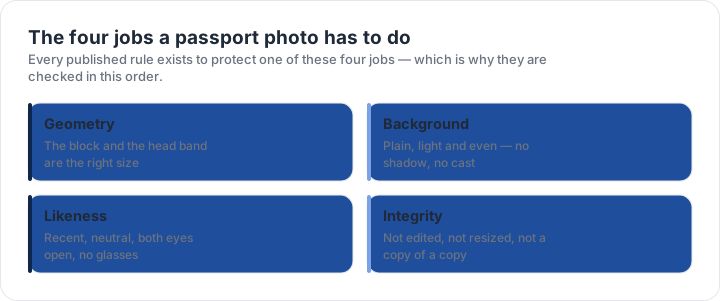
Every published photo rule is one of four jobs in disguise. Geometry: the photo is a block of a fixed size, and the head sits inside a band measured from chin to the top of the head. Background: plain, light and even, because a face-matching system reads the frame edge as well as the face. Likeness: recent enough to be you, neutral, both eyes open. Integrity: not edited, not a scan of a print, not a crop out of a group shot.
Separated that way, the rules stop looking arbitrary. Glasses were banned in the United States in November 2016 because glare across the eye breaks the likeness job, not for any aesthetic reason. The background must be plain so software can find where the head ends. A six-month window exists because faces change, and because a photograph is sometimes compared with a person years later.
The block and the head band
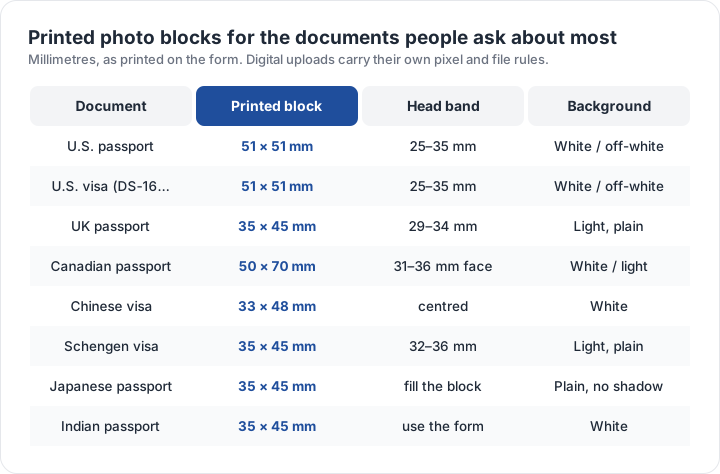
Two numbers drive almost everything. The block is the printed size of the photo: 51 × 51 mm for a U.S. passport, which is exactly 2 × 2 inches; 35 × 45 mm for a UK, Indian, Schengen or Japanese passport; a taller 50 × 70 mm for Canada; and a narrow 33 × 48 mm for a Chinese visa. The head band is how much of that block the head may occupy: 25–35 mm for the United States, 29–34 mm for the United Kingdom, a 31–36 mm face for Canada and 32–36 mm for a Schengen visa.
This is why a photo can be sharp and well lit and still come back. A phone shot taken at arm’s length usually puts the head at 45 to 55 per cent of the frame height, while the required band is closer to 60 to 70 per cent. Nothing is wrong with the image except its proportions — and proportions can be measured before you pay for anything.
Printed photo or digital upload
The same face is filed two different ways with two different rule sets. A printed photo is judged by the block and the head band on paper. A digital upload is judged first by pixels and kilobytes and only then by the face: the UK asks for at least 600 × 750 pixels and a file between 50 KB and 10 MB, the United States accepts a square JPG, PNG or HEIC from 600 × 600 pixels up to 10 MB, and a U.S. visa form wants a square JPEG no larger than 240 KB.
One rule catches more people than any other. In the United States, a photograph of your printed photo is not accepted as a digital upload: the file has to come from the original image, not from a scan or a phone picture of the print.
Where to get one, and what it costs
There are four routes. A shop or post office counter prints it while you wait; two published fees we could re-read in October 2026 are the $15.00 photo fee at a U.S. Post Office and $16.99 for two printed photos with a free digital copy at a Walgreens pharmacy counter. A phone app crops and resizes a photo you already have. Your own camera and a plain wall cost nothing. A mail-in service handles awkward blocks no local counter keeps in stock.
Whichever route you take, compare the result with the number printed on your form before you file. That is what the free checker is for: it measures the block, the head height between two guide lines you drag, the background lightness and the file limits, inside your browser, with nothing uploaded. If you would rather read the numbers first, the size matrix lists every block on this site, and the country guides start with the United States.
| Requirement | What the official rule says | |||||||
|---|---|---|---|---|---|---|---|---|
| ('Country / document', 'United States — U.S. passport — printed photo') | ('Printed size', '51 × 51 mm (2 × 2 in)') | ('Head height', '25–35 mm chin to top of head') | ('Digital upload', 'Not applicable — this one is filed on paper') | ('File format & size', 'Photo paper, no file limits') | ('Background', 'Plain white or off-white, no shadows') | ('Recency', 'Taken within the last 6 months') | ('Glasses', 'No glasses — the rule changed in November 2016') | ('Official source', 'Official page') |
| ('Country / document', 'United Kingdom — UK passport — printed photo') | ('Printed size', '35 × 45 mm (1.38 × 1.77 in)') | ('Head height', '29–34 mm chin to top of head') | ('Digital upload', 'Not applicable — this one is filed on paper') | ('File format & size', 'Photo paper, no file limits') | ('Background', 'Plain cream or light grey background') | ('Recency', 'Taken in the last month') | ('Glasses', 'No glasses') | ('Official source', 'Official page') |
| ('Country / document', 'Canada — Canadian passport — printed photo') | ('Printed size', '50 × 70 mm') | ('Head height', '31–36 mm chin to top of head') | ('Digital upload', 'Not applicable — this one is filed on paper') | ('File format & size', 'Photo paper, no file limits') | ('Background', 'Plain white or light-coloured background') | ('Recency', 'Taken within the last 6 months') | ('Glasses', 'Dark glasses and tinted lenses not accepted; clear prescription glasses must not hide the eyes') | ('Official source', 'Official page') |
| ('Country / document', 'India — Indian passport — printed photo') | ('Printed size', '35 × 45 mm') | ('Head height', 'Not specified as a fixed band — keep the head centred and uncropped') | ('Digital upload', 'Not applicable — this one is filed on paper') | ('File format & size', 'Photo paper, no file limits') | ('Background', 'Plain white background') | ('Recency', 'Recent — not older than the application period stated on the form') | ('Glasses', 'Remove glasses if possible; glare across the eyes is a common rejection') | ('Official source', 'Official page') |
| ('Country / document', 'China — Chinese visa — printed photo') | ('Printed size', '33 × 48 mm') | ('Head height', 'Not specified as a fixed band — keep the head centred and uncropped') | ('Digital upload', 'Not applicable — this one is filed on paper') | ('File format & size', 'Photo paper, no file limits') | ('Background', 'Plain white background') | ('Recency', 'Taken within the last 6 months') | ('Glasses', 'No glasses; no headwear except religious headwear') | ('Official source', 'Official page') |
| ('Country / document', 'Europe — Schengen visa — printed photo') | ('Printed size', '35 × 45 mm') | ('Head height', '32–36 mm chin to top of head') | ('Digital upload', 'Not applicable — this one is filed on paper') | ('File format & size', 'Photo paper, no file limits') | ('Background', 'Plain light background') | ('Recency', 'Taken within the last 6 months') | ('Glasses', 'No glasses; eyes must be clearly visible') | ('Official source', 'Official page') |
| ('Country / document', 'Japan — Japanese passport — printed photo') | ('Printed size', '35 × 45 mm') | ('Head height', 'Not specified as a fixed band — keep the head centred and uncropped') | ('Digital upload', 'Not applicable — this one is filed on paper') | ('File format & size', 'Photo paper, no file limits') | ('Background', 'Plain background, no shadows') | ('Recency', 'Taken within the last 6 months') | ('Glasses', 'No glasses with coloured or dark lenses') | ('Official source', 'Official page') |
| ('Country / document', 'Australia — Australian passport — printed photo') | ('Printed size', '35 × 45 mm') | ('Head height', 'Not specified as a fixed band — keep the head centred and uncropped') | ('Digital upload', 'Not applicable — this one is filed on paper') | ('File format & size', 'Photo paper, no file limits') | ('Background', 'Plain light background') | ('Recency', 'Taken within the last 6 months') | ('Glasses', 'No glasses; no glare across the eyes') | ('Official source', 'Official page') |
Specification source: https://travel.state.gov/content/travel/en/passports/how-apply/photos.html · checked October 2026 · DS-11, DS-82 by mail, and any paper application.
Specification source: https://www.gov.uk/photos-for-passports/photo-requirements · checked October 2026 · Paper application (form for overseas or postal applications).
Specification source: https://www.canada.ca/en/immigration-refugees-citizenship/services/canadian-passports/photos.html · checked October 2026 · Paper application, 2 identical photos.
Specification source: https://www.visaforchina.cn/ · checked October 2026 · Visa application submitted to a Chinese visa centre.